199 CHARACTERISTICS OF CHAMOIS (RUPICAPRA PYRENAICA PARVA) EPIDIDYMAL SPERMATOZOA DEPENDING ON TIME POSTMORTEM
L. Anel A , F. Martinez-Pastor B , M. Kaabi A , V. Garcia-Macias A , M. Alvarez A , E. Anel A , P. Herraez B and P. de Paz BA Animal Reproduction and Obstetrics, University of Leon, Leon, Spain;
B Cell Biology and Anatomy, University of Leon, Leon, Spain. email: dbcfmp@unileon.es
Reproduction, Fertility and Development 16(2) 220-221 https://doi.org/10.1071/RDv16n1Ab199
Submitted: 1 August 2003 Accepted: 1 October 2003 Published: 2 January 2004
Abstract
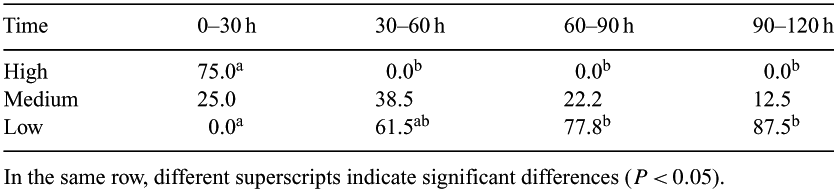
The Spanish Cantabrian chamois (Rupicapra pyrenaica parva) is a wild ruminant of the Cantabric Mountains (North of Spain). It is not an endangered species, but it is vulnerable to sarcoptic mange outbreaks and it is appreciated as a hunting trophy. The aim of the present study, as part of a project for establishing genetic resource banks for wild species in the North of Spain, was to determine the effect of postmortem time (PT) on epididymal sperm quality. We obtained 37 sets of testes from males hunted during the breeding season (autumn). The samples, with testes inside of the scrotum to prevent drying, were cooled to 5°C, and processed at 4 different PTs (0–30 h, 30–60 h, 60–90 h, 90–120 h). Sperm was obtained from incisions made in the caudal epididymis. Osmolality (OSM) and pH of the undiluted fluid were measured with a cryoscopic osmometer (Osmomat-030, Gonotec TM; Berlin) and an electronic pH-meter (CG 837, SchottTM; Mainz, Germany), respectively. Sperm motility (M) and progressive motility (PM) were assessed subjectively at 37°C. An aliquot of sperm was fixed in glutaraldehyde and used to evaluate acrosome integrity (ACR) and abnormal forms (heads, AH; midpieces, AM; tails, AT). Membrane functionality (MF) was assessed by means of the HOS test (100 mOsm kg−1, 18 min). All analyses were carried out using a phase-contrast microscope (×100 for motility and ×400 for other analyses). We obtained the Spearman correlation coefficients between the analyzed parameters and PT. Samples were graded on sperm quality parameters (PM, ACR and MF: >60%, high; 60–30%, medium; <30%, low), and their distribution among PT groups was compared (χ2, P < 0.05). The following parameters correlated significantly with PT (r and P are shown): pH (0.37, 0.008), OSM (0.52, <0.001), M (−0.51, <0.001), PM (−0.62, <0.001), MF (−0.44, 0.001), ACR (−0.33, 0.02), AT (0.41, 0.005). The correlations of pH and osmolality indicate changes in epididymal fluid composition which could impair sperm viability. In fact, sperm motility, acrosome integrity and membrane functionality showed negative correlations. Also, AT increased with PT, which could be related to membrane damage (along with MF decrease). The distribution of the samples in quality groups is shown in the Table 1. There were no low quality samples in the 0–30 h group, but the proportion of such samples increased significantly with PT. In conclusion, epididymal sperm characteristics changed with PT, showing a remarkable loss of quality after the first 30 h. Even so, it was still possible to find samples of acceptable quality after several days. This is an important observation when collecting samples for genome resource banking. However, it will be necessary to assess the fertilizing ability of sperm stored for extended periods postmortem to confirm the utility of these findings.
|