
199 BASIC CHARACTERISTICS AND CRYOBANKING OF BARBARY SHEEP (AMMOTRAGUS LERVIA) SEMEN
S.S. Pérez-Garnelo A , C. Borque A , N. Madrid-Bury A , M. Delclaux B , C. Talavera B , E. Martínez B , A.T. Palasz A and J. De La Fuente AA Departamento de Reproducción Animal, INIA, Madrid, Spain
B Zoo-Aquarium de Madrid, 28011 Madrid, Spain. Email: sgarnelo@inia.es
Reproduction, Fertility and Development 17(2) 249-250 https://doi.org/10.1071/RDv17n2Ab199
Submitted: 1 August 2004 Accepted: 1 October 2004 Published: 1 January 2005
Abstract
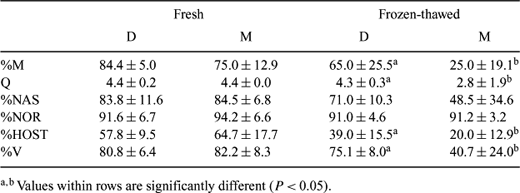
Barbary sheep (Ammotragus lervia) are considered vulnerable species by the World Conservation Union (IUCN). The purpose of this study was to describe the basic characteristics of fresh semen, test the efficacy of commercial extender Triladyl, and collect necessary data that may help to create a frozen semen bank for the Barbary sheep in Spain. A total of 21 ejaculates were collected by rectal-probe electroejaculation from one dominant (D) and three minor (M) adult males housed in the Madrid Zoo. After ejaculation, semen volume, concentration, and mass motility were assessed. Remaining raw semen was diluted at 37°C with TRIS-based extender Triladyl (Minitüb, Tiefenbach, Germany) and 20% egg yolk to a final concentration of 200 × 106 sperm per mL. Diluted samples were kept at 5°C for 4 h and then loaded into 0.25-mL French straws, frozen at 5 cm above liquid nitrogen (LN2) for 10 min and then plunged into LN2. Samples were thawed in a water bath at 37°C for 30 s. Post-thaw semen survival was evaluated by sperm motility (%M), quality of movement (Q), normal acrosome status (%NAS), normal sperm morphology (%NOR), membrane integrity (hypo-osmotic test; %HOST), and sperm viability (eosin-nigrosin vital staining; %V), and were compared with the same parameters in the fresh semen. Data between D and M males were analyzed by one way ANOVA. Mean volume of ejaculates, total sperm concentration and mass motility of raw semen were respectively; 5.2 ± 1.56 mL, 2800.0 ± 1290.5 × 106 and 3.4 ± 0.4 for the D male, and 3.5 ± 3.2 mL, 251.2 ± 103.9 × 10⁶, and 1.88 ± 1.4 for M males (P < 0.05). Remaining semen parameters evaluated in raw semen showed no differences between D and M males. However, post-thaw semen quality was significantly (P < 0.05) reduced in all analyzed parameters except %NAS and %NOR in M males groups as compared to the D male (Table 1). It can be concluded that Barbary sheep raw semen collected by electroejaculation is of sufficient quality to be used in an artificial insemination program and can be successfully frozen in commercially available Triladyl extender. However, the post-thaw viability of semen may considerably depend on the male reproductive status in the flock.
|
This work was supported by CAM 07B/007/1999 (Analysis of ejaculate traits and development of methods of semen preservation in wild ungulates from the Madrid Zoo).