
380 COMPARISON OF TRANSGENE EXPRESSIONS BY ICSI AND PRONUCLEAR MICROINJECTION IN MURINE AND PORCINE EMBRYOS
H. Saito A , H.-O. Kawano A , M. Kurome A , R. Tomii A , S. Ueno A , K. Hiruma A and H. Nagashima ALaboratory of Developmental Engineering, Department of Life Science, School of Agriculture, Meiji University, Kawasaki, Kanagawa, Japan
Reproduction, Fertility and Development 18(2) 297-297 https://doi.org/10.1071/RDv18n2Ab380
Published: 14 December 2005
Abstract
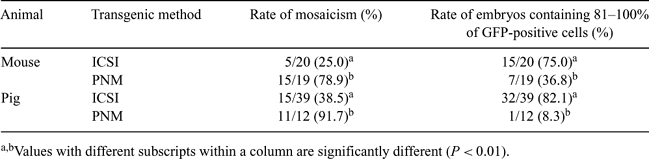
Intracytoplasmic sperm injection (ICSI) of DNA-binding sperm produces transgenic offspring as effectively as pronuclear microinjection (PNM). A significant difference in these two methods is that DNA is introduced into MII oocytes during ICSI, which is likely to allow earlier gene integration compared to PNM. This leads us to hypothesize that ICSI reduces the chance of development of a mosaic embryo, a mixture of transgene-positive and -negative cells. To test this hypothesis, we compared expression patterns of the green flourescent protein (GFP) gene introduced by ICSI and PNM into murine and porcine oocytes. For ICSI, 2 to 5 × 10⁵/μL of sperm frozen-thawed in CZB (for mice) or NIM (for pigs) were co-incubated with 2.5 ng/μL of transgene fragments (CAG-EGFP; 3 kb) for 5 min. Murine sperm were microinjected into in vivo-matured oocytes, and porcine sperm into in vitro-matured oocytes. PNM was performed by microinjection of several picoliters of the transgene fragments (10 ng/μL) into pronuclei of in vivo-fertilized oocytes for mice and in vitro-matured and -fertilized oocytes for pigs. ICSI and PNM embryos were cultured in vitro to the morula stage and treated with 0.5% pronase to remove the zona pellucida. These morulae were disassembled into individual blastomeres by pipetting into PBS containing 100 μM EDTA and examined for GFP expression under fluorescence microscopy. As shown in Table 1, the rate of mosaicism in GFP-expressing embryos was significantly lower for ICSI than for PNM (P < 0.01). In addition, GFP-expressing ICSI embryos were likely to contain high percentages, 81 to 100%, of GFP-positive cells, whereas GFP-expressing PNM embryos were significantly less likely to contain such high percentages of GFP-positive cells (P < 0.01). From these results, we conclude that transgenesis by ICSI was less likely to produce mosaic embryos, and that produced transgenic embryos contained higher proportions of transgene-positive cells, although genomic integration remains to be determined.
|
This work was supported by PROBRAIN.