
259 ADDITION OF CHOLESTEROL TO FLOW-SORTED BULL SPERMATOZOA TO ENHANCE CRYOSURVIVAL DOES NOT AFFECT THE ACROSOME REACTION
E. G. Crichton A , J. K. Graham B and J. L. Schenk AA XY Inc., Fort Collins, CO, USA;
B Colorado State University, Fort Collins, CO, USA
Reproduction, Fertility and Development 20(1) 209-210 https://doi.org/10.1071/RDv20n1Ab259
Published: 12 December 2007
Abstract
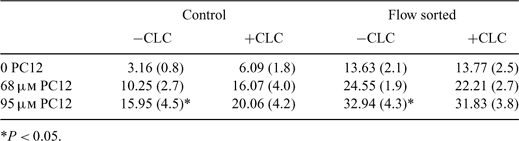
Treating bull sperm with cholesterol-loaded cyclodextrins (CLCs) improves post-thaw motility and viability (Purdy and Graham 2004 Biol. Reprod. 71, 522–527). Unpublished research in our laboratory demonstrated similar improvements for cryosurvival of CLC-treated sex-sorted bull sperm. Our objective was to determine the effects of CLCs on the dilauroylphosphatidylcholine (PC12)-induced acrosome reaction of flow-sorted and non-sorted (control), frozen/thawed bull sperm. Sperm concentrations (3 ejaculates, 4 bulls) were adjusted to 200 × 106 sperm mL–1 with TALP without Ca++. Sperm for sorting were stained (63 μm Hoechst 33342, 34.5°C, 45 min), and then incubated an additional 15 min with 2.5 mg CLC in TALP (+CLC) or an equivalent volume of TALP without CLCs (–CLC), adjusted to 100 × 106 sperm mL–1 with 4% egg yolk TALP containing 0.002% food dye, filtered, and ‘bulk’ sorted (Schenk et al. 1999 Theriogenology 52, 1375–1391) into 2.0 mL aliquots of 20% egg yolk Tris buffer. Controls were extended in 20% egg yolk Tris A to result in a final concentration of 21 × 106 sperm mL–1. All samples were cooled to 5°C over 90 min, and Tris buffer with (controls) or without (flow-sorted) egg yolk (12% glycerol) was added (v/v). Sorted samples were centrifuged (850g, 20 min), and pellets were suspended in 20% egg yolk/6% glycerol Tris, resulting in 21 × 106 sperm mL–1. Sperm were loaded into 0.25-mL straws and frozen over LN2 vapor. Straws were subsequently thawed (30 s, 37°C), and 25 million sperm/treatment were centrifuged through 60% Percoll® to remove egg yolk. Pellets were adjusted to 20 × 106 sperm mL–1 with TALP containing 2.0 mm Ca++. Aliquots (30 μL) were stained with propidium iodide (PI) and fluorescein isothiocyanate–peanut agglutinin (FITC-PNA); treated with 0, 25, or 35 μL PC12; and brought to a constant volume (300 μL) with TALP. TALP (30 μL) containing 42 mm Ca++ was added, resulting in final concentrations of 0, 68, and 95 μm PC12 and 6 mm Ca++. Following incubation (38°C, 35–40 min) 50 000 sperm were analyzed on an SX MoFlo® (Dako, Fort Collins, CO, USA) to determine the percentage of live acrosome-reacted sperm/live sperm(PI –ve, FITC +ve). There were no differences between CLC-treated and non-treated sorted or non-sorted sperm (Table 1) suggesting that, as previously shown for non-sorted sperm (Purdy and Graham 2004), treatment of flow-sorted sperm with CLCs does not interfere with the progression of the acrosome reaction.
|