
The climate change risk management matrix for the grazing industry of northern Australia
David H. Cobon A F , Grant S. Stone B , John O. Carter B , Joe C. Scanlan B D , Nathan R. Toombs A , Xike Zhang A , Jacqui Willcocks C and Greg M. McKeon B EA Queensland Climate Change Centre of Excellence, Environmental Protection Agency, 203 Tor Street, Toowoomba, Qld 4350, Australia.
B Queensland Climate Change Centre of Excellence, Environmental Protection Agency, 80 Meiers Road, Indooroopilly, Qld 4068, Australia.
C Office of Climate Change, Environmental Protection Agency, Ann Street, Brisbane, Qld 4000, Australia.
D Present address: Queensland Department of Primary Industries and Fisheries, 203 Tor Street, Toowoomba, Qld 4350, Australia.
E Land & Water Australia Senior Research Fellowship.
F Corresponding author. Email: David.Cobon@climatechange.qld.gov.au
The Rangeland Journal 31(1) 31-49 https://doi.org/10.1071/RJ08069
Submitted: 5 December 2008 Accepted: 3 February 2009 Published: 26 March 2009
Abstract
The complexity, variability and vastness of the northern Australian rangelands make it difficult to assess the risks associated with climate change. In this paper we present a methodology to help industry and primary producers assess risks associated with climate change and to assess the effectiveness of adaptation options in managing those risks. Our assessment involved three steps. Initially, the impacts and adaptation responses were documented in matrices by ‘experts’ (rangeland and climate scientists). Then, a modified risk management framework was used to develop risk management matrices that identified important impacts, areas of greatest vulnerability (combination of potential impact and adaptive capacity) and priority areas for action at the industry level. The process was easy to implement and useful for arranging and analysing large amounts of information (both complex and interacting). Lastly, regional extension officers (after minimal ‘climate literacy’ training) could build on existing knowledge provided here and implement the risk management process in workshops with rangeland land managers. Their participation is likely to identify relevant and robust adaptive responses that are most likely to be included in regional and property management decisions. The process developed here for the grazing industry could be modified and used in other industries and sectors.
By 2030, some areas of northern Australia will experience more droughts and lower summer rainfall. This poses a serious threat to the rangelands. Although the impacts and adaptive responses will vary between ecological and geographic systems, climate change is expected to have noticeable detrimental effects: reduced pasture growth and surface water availability; increased competition from woody vegetation; decreased production per head (beef and wool) and gross margin; and adverse impacts on biodiversity. Further research and development is needed to identify the most vulnerable regions, and to inform policy in time to facilitate transitional change and enable land managers to implement those changes.
Additional keywords: impact, adaptation, vulnerability, policy, decision making, adaptive action.
Acknowledgements
The authors would like to thank the participants at Longreach workshop, and Alan Peacock who helped with design and graphics. Greg McKeon gratefully acknowledges the support of a Land & Water Senior Research Fellowship.
ABARE
(2007) ‘Statistical tables’. Australian Commodities 14(3), 541–577.
(accessed 4 February 2009).
Ansoff I.
(1957) Strategies for diversification. Harvard Business Review 35(5), 113–124.
(accessed 4 February 2009).
Daly J. J.
(1983) The Queensland beef industry from 1930 to 1980: Lessons from the past. Queensland Agricultural Journal 109(2), 61–97.
(accessed 4 February 2009).
Hall W. B.,
McKeon G. M.,
Carter J. O.,
Day K. A.,
Howden S. M.,
Scanlan J. C.,
Johnston P. W., Burrows W. H.
(1998) Climate change in Queensland’s grazing lands: II. An assessment on the impact on animal production from native pastures. The Rangeland Journal 20, 177–205.
| Crossref | GoogleScholarGoogle Scholar |
(accessed 4 February 2009).
McKeon G. M.,
Stone G. S.,
Syktus J. I.,
Carter J. O.,
Flood N. R.,
Ahrens D. G.,
Bruget D. N.,
Chilcott C. R.,
Cobon D. H.,
Cowley R. A.,
Crimp S. J.,
Fraser G. W.,
Howden S. M.,
Johnston P. W.,
Ryan J. G.,
Stokes C. J., Day K. A.
(2009) Climate change impacts on northern Australian rangeland livestock carrying capacity: a review of issues. The Rangeland Journal 31, 1–29.
(accessed 4 February 2009).
Warrick R. A.
(2000) Strategies for vulnerability and adaptation assessment in the context of national communications. Asia-Pacific Journal for Environmental Development 7, 43–51.

*Consumer price index is a measure of the average price of consumer goods and services purchased by households.
Appendix 1. List of impacts developed to assist in defining consequence categories

|
Appendix 2. Consequence categories for climate change on the grazing industry in northern Australia
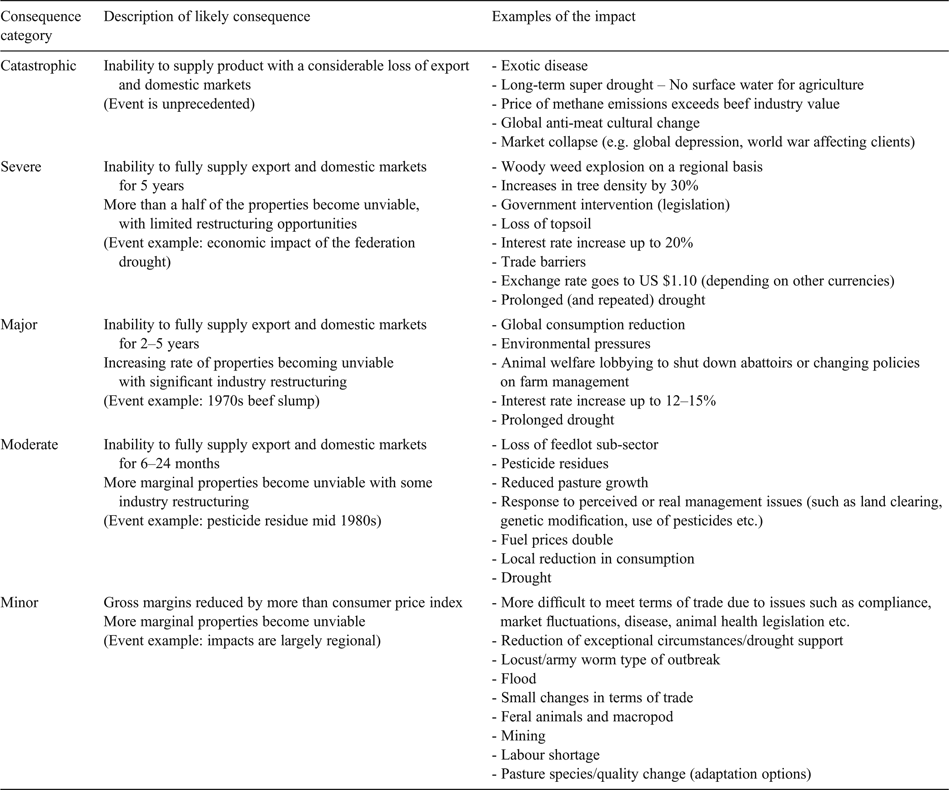
|
Appendix 3. Likelihood of recurrent and single events occurring given that the climate changes (source AGO 2006)
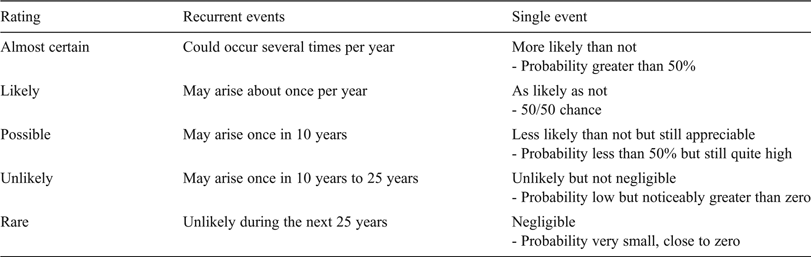
|
Appendix 4. Reference list for Tables 2 and 3
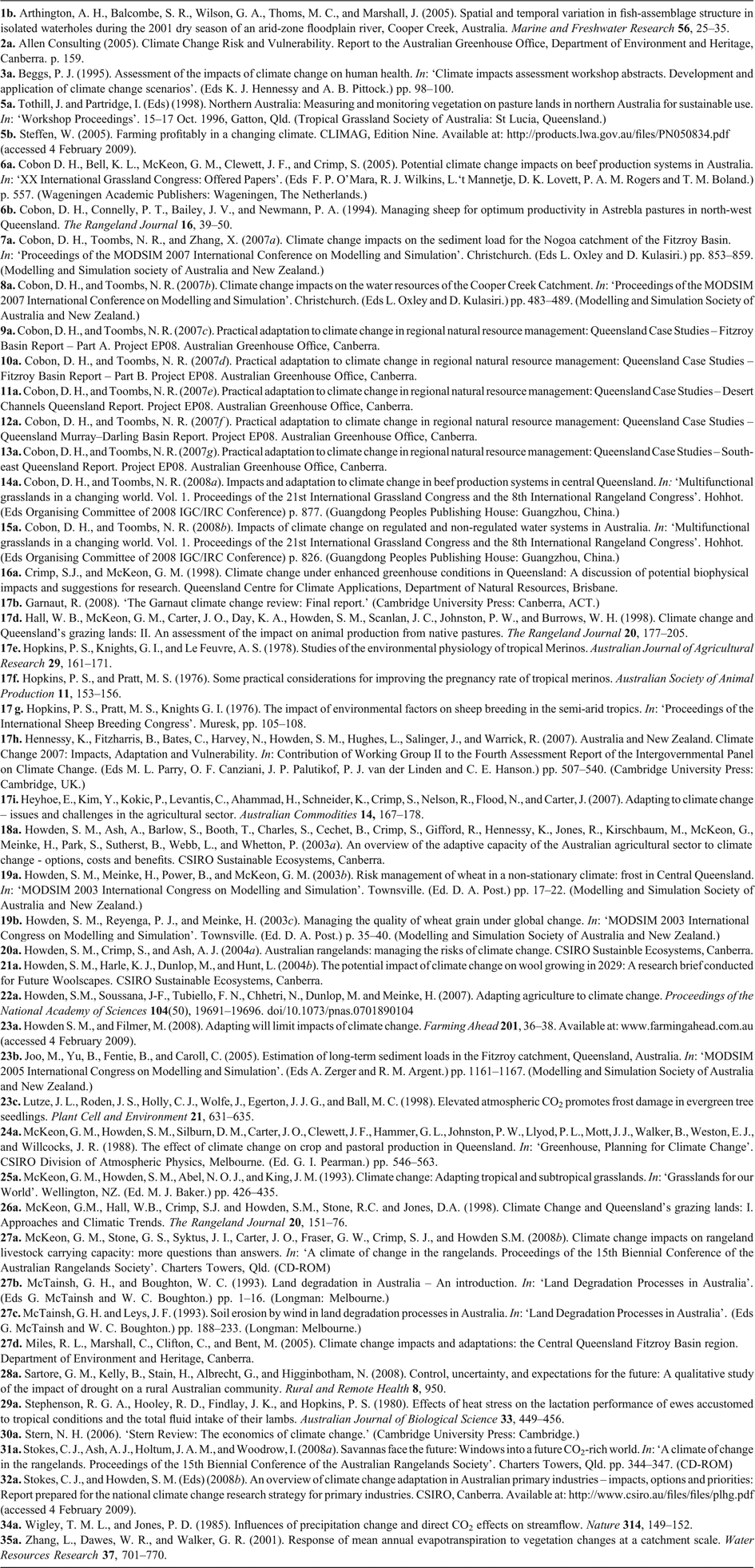
|