
Two new, sympatric species of Wahlenbergia (Campanulaceae) from the New England Tableland escarpment, New South Wales, Australia
George T. Plunkett A , Jeremy J. Bruhl A B and Ian R. H. Telford AA Botany and N.C.W. Beadle Herbarium, University of New England, Armidale, NSW 2351, Australia.
B Corresponding author. Email: jbruhl@une.edu.au
Australian Systematic Botany 22(5) 319-331 https://doi.org/10.1071/SB09021
Submitted: 8 May 2009 Accepted: 13 July 2009 Published: 28 October 2009
Abstract
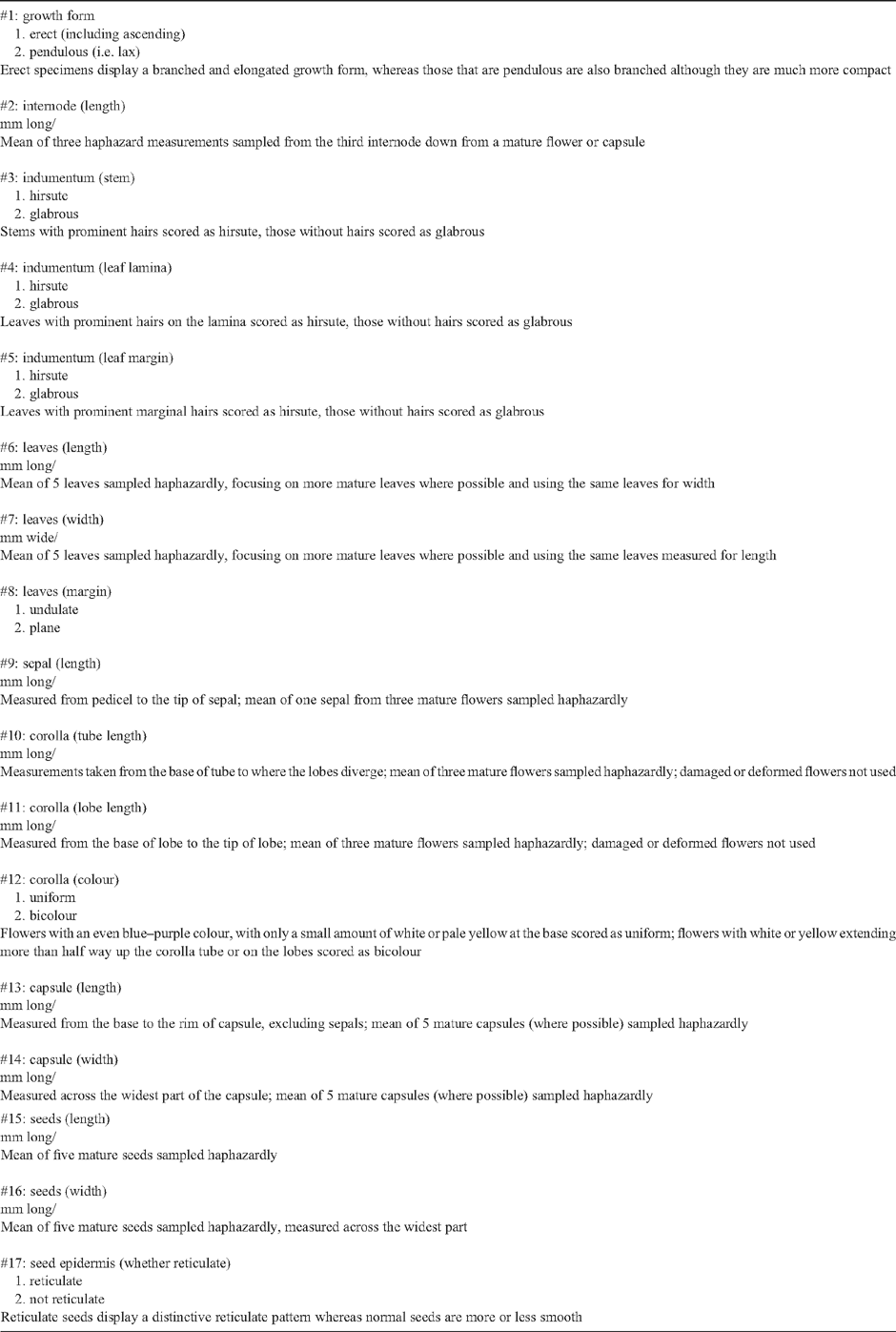
The status of two putative new species of Wahlenbergia sympatric on the New England Tableland escarpment was investigated with morphometric analyses of a database derived from vegetative, floral and fruit characters and scanning electron microscopic studies of seeds. The following new species are described: W. rupicola G.T.Plunkett & J.J.Bruhl and W. telfordii G.T.Plunkett & J.J.Bruhl. Their distributions, habitats and conservation status are noted.
Acknowledgements
Thanks go to Mal Dwyer (NSW NPWS) for a long day at Point Lookout and Darkies Point collecting specimens; Lachlan Copeland (UNE) for his collections and assistance with map; Mohammad Fatemi (UNE) for his assistance with image editing; Patrick Littlefield (Electron Microscope Unit, UNE) for help with SEM, and Lyn Craven (CANB) for Latin diagnoses. Use of the N.C.W. Beadle Herbarium and support from the School of Environmental and Rural Science, UNE, are also acknowledged. We thank Tony Bradshaw and Sophie Tran of Coherent for the use of a Joel JCM-5000. Thanks also go to two anonymous referees for useful comments. Collecting in NSW National Parks was under Scientific Licence S11043.
Carolin RC
(1964) Taxonomic and nomenclatural notes on the genus Wahlenbergia in Australia. Proceedings of the Linnean Society of New South Wales 86, 235–240.

Lothian N
(1947) Critical notes on the genus Wahlenbergia Schrader; with descriptions of new species in the Australian region. Proceedings of the Linnean Society of New South Wales 71, 212–214.
Petterson JA
(1997) Revision of the genus Wahlenbergia (Campanulaceae) in New Zealand. New Zealand Journal of Botany 35, 9–54.
Smith PJ
(1992) A revision of the genus Wahlenbergia (Campanulaceae) in Australia. Telopea 5, 91–175.
Thulin M
(1987) New species of Wahlenbergia (Campanulaceae) from Africa. Nordic Journal of Botany 7, 261–265.
| Crossref | GoogleScholarGoogle Scholar |
Wills KE,
Whalley RDB, Bruhl JJ
(2000) Systematic studies in Paniceae (Poaceae): Homopholis and Whalleya gen. et sp. nov. Australian Systematic Botany 13, 437–468.
| Crossref | GoogleScholarGoogle Scholar |

|
|