
Revision of coelotine spiders from Nepal (Araneae : Amaurobiidae)
Xin-Ping Wang A C and Jochen Martens BA College of Life Sciences, Hebei University, Baoding, Hebei 071002, China.
B Institut of Zoology, Johannes Gutenberg-University Mainz, Department of Systematic Zoology, Müllerweg 6, D-55099 Mainz, Germany.
C Corresponding author. Emails: wang@amaurobiidae.com, xinping_wang@yahoo.com
Invertebrate Systematics 23(5) 452-505 https://doi.org/10.1071/IS09009
Submitted: 14 February 2009 Accepted: 10 October 2009 Published: 16 December 2009
Abstract
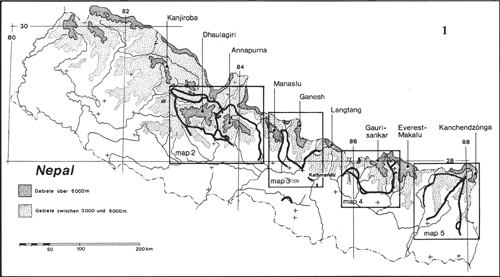
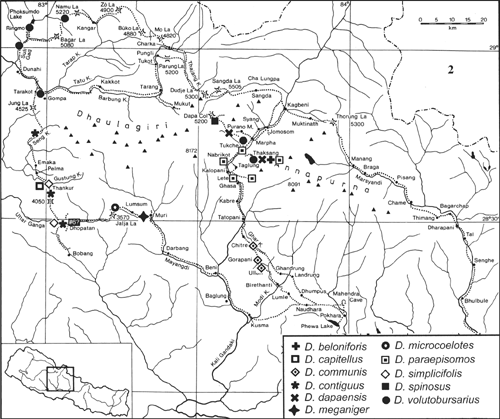
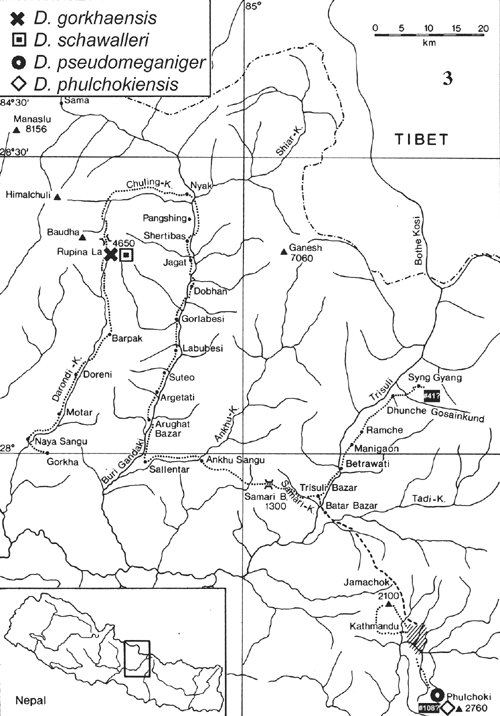
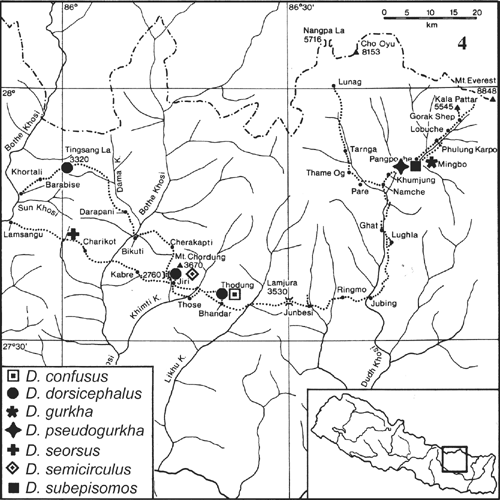
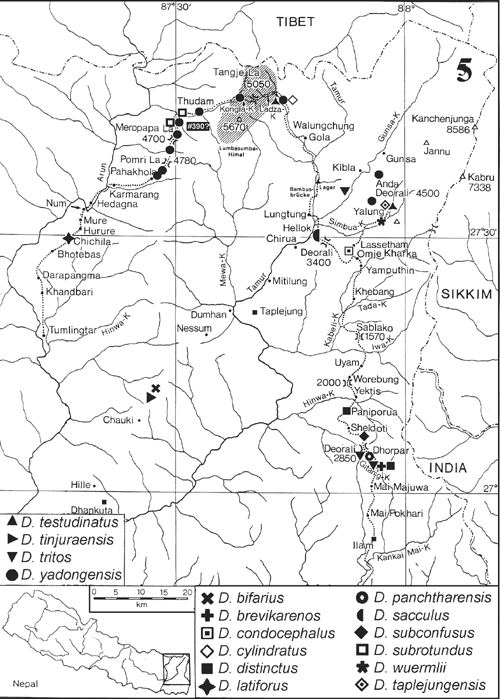
Coelotine spiders from Nepal are studied based on collections from the Himalaya Expeditions of J. Martens carried out in the years 1969, 1970, 1973, 1980, 1983, 1988 and 1995. In total, 38 Nepalese species of the genus Draconarius Ovtchinnikov, 1999 are described, including 35 new species. These are: D. beloniforis, sp. nov. (♂), D. bifarius, sp. nov. (♂), D. brevikarenos, sp. nov. (♀), D. capitellus, sp. nov. (♀), D. communis, sp. nov. (♂♀), D. condocephalus, sp. nov. (♂♀), D. confusus, sp. nov. (♂♀), D. contiguus, sp. nov. (♀), D. cylindratus, sp. nov. (♀), D. dapaensis, sp. nov. (♂), D. distinctus, sp. nov. (♂♀), D. dorsicephalus, sp. nov. (♂♀), D. gorkhaensis, sp. nov. (♂♀), D. gurkha (Brignoli, 1976) (♀), D. latiforus, sp. nov. (♀), D. meganiger, sp. nov. (♀), D. microcoelotes, sp. nov. (♀), D. panchtharensis, sp. nov. (♀), D. paraepisomos, sp. nov. (♂♀), D. phulchokiensis, sp. nov. (♀), D. pseudogurkha, sp. nov. (♀), D. pseudomeganiger, sp. nov. (♀), D. sacculus, sp. nov. (♀), D. schawalleri, sp. nov. (♂), D. semicirculus, sp. nov. (♂♀), D. seorsus, sp. nov. (♀), D. simplicifolis, sp. nov. (♀), D. spinosus, sp. nov. (♂♀), D. subconfusus, sp. nov. (♀), D. subepisomos, sp. nov. (♂♀), D. subrotundus, sp. nov. (♀), D. taplejungensis, sp. nov. (♀), D. testudinatus, sp. nov. (♀), D. tinjuraensis, sp. nov. (♂♀), D. tritos, sp. nov. (♂♀), D. volutobursarius, sp. nov. (♂♀), D. wuermlii (Brignoli, 1978) (♀) and D. yadongensis (Hu & Li, 1987) (♂♀). The male is described for the first time for D. yadongensis. The distribution characteristics of Nepalese coelotines are discussed. The phylogenetic relationships of Coelotinae, including Nepalese coelotines and the two recently established coelotine genera, Lineacoelotes Xu, Li & Wang, 2008 and Notiocoelotes Wang, Xu & Li, 2008 from China and South-east Asia, are analysed using the parsimony method. Our research found that coelotines from Nepal are highly diversified and occur in different clades of the tree. The genus Draconarius is not monophyletic. We assigned all the species examined in this study to Draconarius because they are not congeneric with any existing coelotine genus. Their appropriate placement will be further studied in a future phylogenetic analysis using all coelotine species as terminals.
Acknowledgements
We thank GB Edwards (Florida State Collection of Arthropods, Gainesville, Florida), Charles E. Griswold (California Academy of Sciences, San Francisco, California), and Norman I. Platnick (American Museum of Natural History, New York) for use of the facilities. In addition to the specimens from the Himalaya Expeditions of J. Martens, deposited in the Senckenberg Museum, Frankfurt/M. (J. Martens and P. Jäger), a few additional specimens were available from the Institute of Zoology, Innsbruck (K. Thaler) and Naturhistorisches Museum Basel (A. Hänggi). J. Martens heartily thanks the Feldbausch Foundation and Wagner Foundation at Fachbereich Biologie, Mainz University, for annually granting travel funds to carry out field studies in Asia. Robert Raven and Barbara Baehr (Queensland Museum, South Brisbane), and two anonymous reviewers provided both taxonomic and language editing to the manuscript. Nikolaj Scharff (Zoological Museum, Copenhagen) provided critical comments to the phylogenetic analysis. We thank our Coelotinae colleagues in China for reading and providing valuable comments on an early version of the manuscript: Shu-qiang Li and Jie Liu (Institute of Zoology, Beijing), Xiang Xu (Hunan Normal University, Changsha, Hunan), Ming-sheng Zhu (Hebei University, Baoding, Hebei), and Zhi-sheng Zhang (South-western University, Chongqing). X. P. Wang particularly thanks C. E. Griswold, N. I. Platnick, and Nikolaj Scharff for discussing the English language in species description.
Brignoli P. M.
(1976) Spinnen aus Nepal, III. Über einige Spinnen aus dem Himalaya, dazu Revision einiger Arten aus dem Karakorum (Arachnida, Araneae). Ergebnisse des Forschungsunternehmens Nepal Himalaya 5, 229–253.
[Verified November 2009]
Goloboff P.,
Carpenter J. M.,
Arias J. S., Esquivel D. R. M.
(2008) Weighting against homoplasy improves phylogenetic analysis of morphological data sets. Cladistics 24, 758–773.
| Crossref | GoogleScholarGoogle Scholar |
[Verified November 2009]
Hu J. L., Li A. H.
(1987) The spiders collected from the fields and the forests of Xizang Autonomous Region, China (II). Agricultural Insects, Spiders, Plant Diseases and Weeds of Xizang 2, 247–353.
[Accessed on 1 February 2009]
Liu J., Li S. Q.
(2008a) Four new cave-dwelling Platocoelotes species (Araneae: Amaurobiidae) from Guangxi and Guizhou, China. Zootaxa 1778, 48–58.
[Verified November 2009]
Ono H.
(2008) Five New Spiders of the Families Dictynidae, Cybaeidae, Coelotidae and Ctenidae (Arachnida, Araneae) from Japan. Bulletin of the National Museum of Nature of Science 34(3), 157–171.
[Accessed 1 February 2009]
Wang X. P., Jäger P.
(2007) A revision of some spiders of the subfamily Coelotinae F.O. Pickard-Cambridge 1898 from China: transfers, synonymies, and new species (Arachnida, Araneae, Amaurobiidae). Senckenbergiana Biologica 87, 23–49.

Wang X. P., Jäger P.
(2008) First record of the subfamily Coelotinae in Laos, with review of Coelotinae embolus morphology and description of seven new species from Laos and Vietnam (Araneae, Amaurobiidae). Journal of Natural History 42(35), 2277–2304.
| Crossref | GoogleScholarGoogle Scholar |
Wang X. P., Zhu M. S.
(2009) On the charitonovi species group of the spider genus Coelotes (Araneae, Amaurobiidae) from Middle Asia. The Journal of Arachnology 37, 272–281.
| Crossref |
Wang X. P.,
Tso I. M., Wu H. Y.
(2001) Three new Coelotes species (Araneae: Amaurobiidae) from Taiwan. Zoological Studies 40, 127–133.
Wang X. P.,
Xu X., Li S. Q.
(2008)
Notiocoelotes, a new genus of the spider subfamily Coelotinae from Southeast Asia (Araneae, Amaurobiidae). Zootaxa 1853, 1–17.
Wang X. P.,
Griswold C. E., Ubick D.
(2009) On the pseudoterrestris species group of the spider genus Coelotes (Araneae, Amaurobiidae). Zootaxa In press. ,
Wang X. P.,
Jäger P., Zhang Z. S.
() The genus Taira Lehtinen, 1967, with review on its tibial apophyses and description of four new species (Araneae: Amaurobiidae). The Journal of Arachnology In press ,
Wang X. P.,
Zhu M. S., Li S. Q.
() A review of the coelotine genus Eurocoelotes (Araneae, Amaurobiidae). The Journal of Arachnology In press. ,
Xu X., Li S. Q.
(2008a) New species of the spider genus Platocoelotes Wang, 2002 (Araneae: Amaurobiidae). Revue Suisse de Zoologie 115, 85–94.
Xu X., Li S. Q.
(2008b) Ten new species of the genus Draconarius (Araneae: Amaurobiidae) from China. Zootaxa 1786, 19–34.
Xu X.,
Li S. Q., Wang X. P.
(2008)
Lineacoelotes, a new genus of Coelotinae from China (Araneae: Amaurobiidae). Zootaxa 1700, 1–20.
Zhang Z. Z.,
Zhu M. S., Wang X. P.
(2005)
Draconarius exilis, a new species of coelotine spider from China (Araneae, Amaurobiidae). Zootaxa 1057, 45–50.
† Results of the Himalaya Expeditions of J. MARTENS, No. 267 – For No. 266 see Genus 20(3): 533–537, 2009 (Wroclaw, Poland). – J. M. sponsored by Deutscher Akademischer Austauschdienst and Deutsche Forschungsgemeinschaft.
|
|
|
|
|