The fields of Crystal Engineering, the study and engineering of the crystalline solid state of materials, and Ionic Liquids, the study and engineering of the liquid state of salts that typically melt below 100, would seem at first glance polar opposites, but are they?
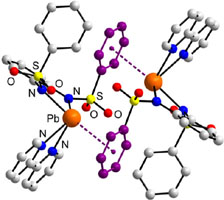
A survey of lead structures containing Pb···π aryl interactions is presented. Pb···π aryl interactions provide stability to their crystal structures and give rise to aggregates of various dimensionality. These supramolecular synthons often arise from the interaction lead's lone pair of electrons with the LUMO of the accepting aryl ring.
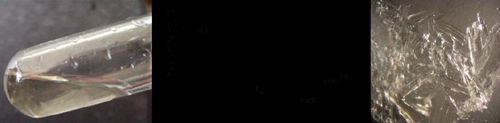
This article aims at giving insight into the liquid–solid phase transition of ionic liquids from the viewpoint of a solid state chemist and wished to contribute to a better understanding of this intriguing class of compounds. The fundamental theories of liquid–solid phase transition will be discussed in the context of ionic liquid chemistry.
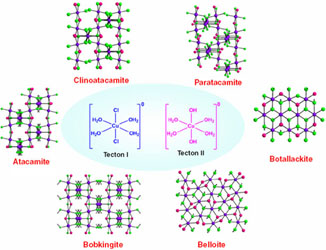
The role of nonbonding interactions in the occurrence of oxide, hydroxide or chloride linkages in oxides, hydroxychlorides, and chlorides of copper based minerals and coordination polymers has been demonstrated for the first time in terms of a mechanistic approach based on supramolecular retrosynthesis. Polymorphs and pseudopolymorphs of copper based minerals can be readily interpreted in terms of aggregation of copper tectonsI and II.
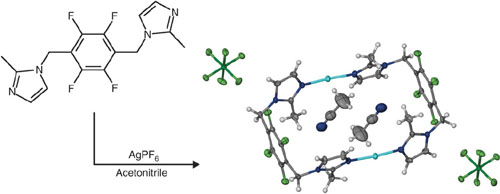
The formation, structure, and single-crystal to single-crystal transformations of the dinuclear metallocycle [Ag2L2](PF6)2·2CH3CN (L = 2,3,5,6-tetrafluoro-1,4-bis(2-methylimidazole-1-yl-methyl)benzene) are described. The acetonitrile guest molecules can be removed without loss of single crystallinity to afford a porous material. CO2 sorption isotherms were recorded at various temperatures and the structures and sorption behaviour of the crystals are compared to those of a previously reported analogous system. Upon exposure to acetone vapour, the desolvated crystals undergo a single-crystal to single-crystal transformation to form the acetone solvate..
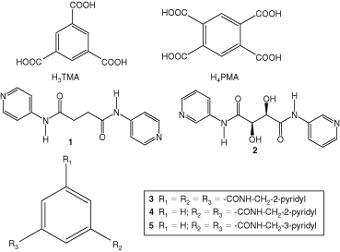
Crystal structures of pyromellitic or trimesic acid salts of pyridine and amide-containing molecules (see Fig.) are determined and analyzed in terms of intermolecular interactions. The symmetry of the components is important in determining the resultant supramolecular synthon and, therefore, the overall architecture. However, the crystal structures were highly unpredictable and did not always follow the rule of hierarchy of interactions.
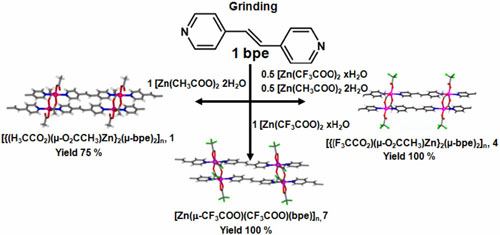
Manual grinding of ZnII acetate and/or trifluoroacetate with 1,2-bis(4,-pyridyl)ethylene (bpe) affords photoreactive ladder coordination polymers whereas solution methods yield an interpenetrating square-grid network with (4,4) topology. The solid-state reactivity has been attributed to the presence of hydrated water in the precursors and the expelled by-products of the reaction.
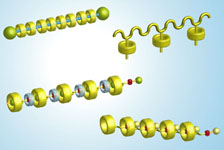
In the past few decades, supramolecular polymers have emerged as novel materials with a wide variety of different functions. In this essay we reflect on the history of supramolecular polymers, their function in various applications and the challenges to be met in the near future.
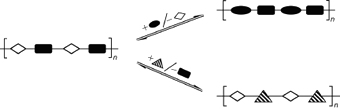
Dynamers are constitutional dynamic polymers, i.e. polymeric entities of either supramolecular or molecular nature, whose monomeric components are linked respectively through reversible non-covalent or covalent connections. They are able to modify their constitution by exchange and reshuffling of their components and therefore to undergo adaptation in response to external chemical or physical triggers.
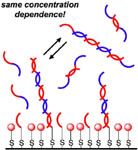
Single-molecule studies reveal that the concentration dependence of supramolecular polymer molecular weight on a surface matches that of the polymers in solution.
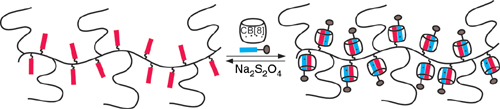
An aqueaous, universal polymeric scaffold based on a water soluble copolymer has been developed. The copolymer backbone can be reversibly modified in a redox-responsive manner with a hydrophilic or hydrophobic derivative through supramolecular ternary complexes with cucurbit[8]uril.
n-Alkyl-linked bis-thymines were synthesized and the effect of spacer length on the photoreactivity examined. n-Alkyl-linked bis-thymines have been supramolecularly aligned with poly(vinyl pyrrolidone) templates and reversibly photopolymerized in the solid state.
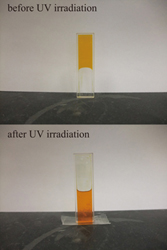
This paper describes a new photoresponsive organogelator based on tris(phenyl isoxazolyl)benzene possessing azobenzene moieties. The trans-isomer assembles to form a supramolecular fibrous assembly that shows remarkable gelation properties. The photoisomerization of the trans- to cis-isomer completely disrupts the gel phase to give rise to the sol.
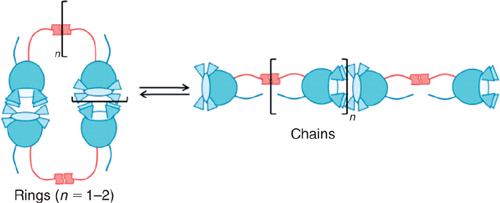
The concentration and temperature dependent ring-chain equilibrium is investigated for a new family of supramolecular polymers formed by ditopic quinoxaline-velcrand monomers, which are able to combine solvophobic interactions and multiple H-bonding. The orthogonality and selectivity of the involved binding motifs, and the reversible nature of the obtained architectures are demonstrated.
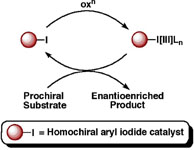
Recently, new chiral aryl iodides, and conditions for their substoichiometric use, have allowed catalytic enantioselective polyvalent iodine mediated reactions to be achieved. This highlight draws attention to recent discoveries in this emerging field.
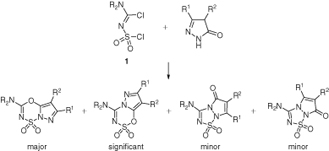
N,N-dialkyl-N′-chlorosulfonylchloroformamidines 1, versatile 1,3-dielectrophiles for the synthesis of new heterocycles, react with pyrazol-3-ones under a variety of conditions to afford two previously unknown pyrazolo-fused oxathiadiazine ring systems. Also formed were minor amounts of two trioxo isomers of a rare pyrazolo-fused thiatriazole ring system, which arise from the pyrazol-3-ones acting via alternative modes of dinucleophilic substitution.
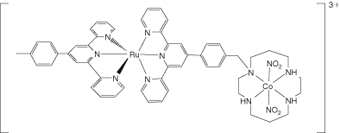
A series of ditopic ligands bearing terpyridyl and polyamine coordination sites have been prepared. RuII complexes of these ligands appear vulnerable to nucleophilic displacement of the polyamine portion of the ligand by BH44–. RuII–CoIIII heterodinuclear complexes in which the CoIII centre is coordinated by a cyclam macrocycle have been prepared.
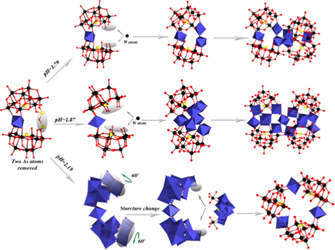
A new fragment [H2As4W19O70]12- was synthesized and used to construct the huge polytungstoarsenate clusters 2, 3, and 4. Polyoxoanion 2 is composed of four trivacant Keggin B-α-type [AsW9O33] units, encapsulating a zonal W13 cluster {W13O32(OH)4(H2O)6}, the first observed in polyoxometalate chemistry.
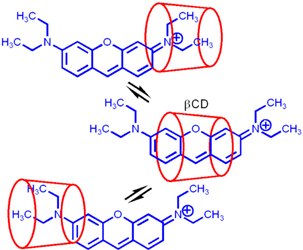
The complexation of cationic pyronine B (PB+) and Y (PY+), by β-cyclodextrin (βCD) and two linked βCD dimers, has been studied by UV-vis, fluorescence and 1H NMR spectroscopy. The modes of pyronine B and Y complexation, dimerization, and fluorescence quenching are discussed.
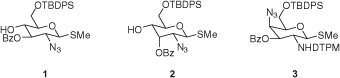
The large scale synthesis of three orthogonally protected monosaccharide scaffolds (1–3) suitable for use in the solid phase preparation of large diversity libraries is presented.
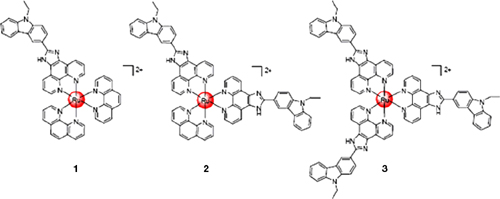
Three novel ruthenium(II) complexes, [Ru(phen)2(Hecip)]2+ (1), [Ru(phen)(Hecip)2]2+ (2), and [Ru(Hecip)3]2+ (3) are found to act as luminescent pH switches with maximum on–off ratios of 17, 230, and 90, respectively. Such molecular switches may find potential applications as trigger elements to control a material's properties.
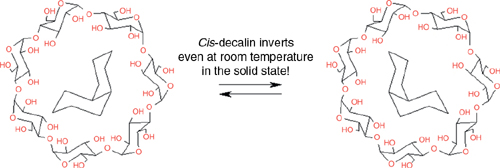
For many years cyclodextrins were erroneously considered to have a rigid structure. However, their flexibility allows the guest, cis-decalin, in the inclusion complex with β-cyclodextrin to invert in the solid state even at room temperature. The observation disagrees with the usually observed freezing of internal movement in the solid state.
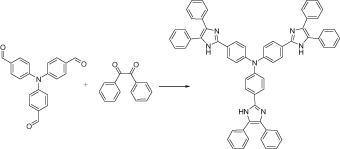
A series of the novel bipolar triphenylamine-benzimidazole derivatives, containing both hole-transporting and electron-transporting moieties, have been synthesized and characterized. Quantum chemical calculations were used to obtain the optimized ground-state geometries of these compounds. All of the compounds exhibited high fluorescence quantum yields, desirable HOMO levels (-5.42 to -5.08 eV) and high thermal stabilities, which supports their potential application in organic light-emitting diodes materials.
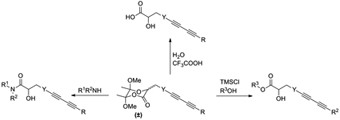
Several diyne substituted 2-hydroxy acids and derivatives have been prepared. Alkylation of butane-2,3-diacetal protected glycolic acid with haloalkyl substituted diyne compounds gave the corresponding diacetal protected diyne substituted 2-hydroxy acids. Diacetal deprotection through acid mediated hydrolysis, transesterification or aminolysis afforded the 2-hydroxy-diyne acid, ester or amide derivatives, respectively.
The publication rate on RAFT polymerization continues to increase with the latest publication of a third update. Freely access the three reviews previously written by CSIRO scientists Moad, Rizzardo, and Thang on this subject in Australian Journal of Chemistry.