
The potential for developing fodder plants for the salt-affected areas of southern and eastern Australia: an overview
M. E. Rogers A B N , A. D. Craig A C , R. E. Munns A D , T. D. Colmer A E , P. G. H. Nichols A F , C. V. Malcolm G , E. G. Barrett-Lennard A F , A. J. Brown A H , W. S. Semple I , P. M. Evans A J , K. Cowley D , S. J. Hughes A K , R. Snowball A F , S. J. Bennett A , G. C. Sweeney A L , B. S. Dear A M and M. A. Ewing AA Cooperative Research Centre for Plant-based Management of Dryland Salinity, Crawley, Perth, WA 6009, Australia.
B Department of Primary Industries Victoria, Tatura, Vic. 3616, Australia.
C South Australian Research and Development Institute, Struan Agricultural Centre, Naracoorte SA 5271, Australia.
D CSIRO Plant Industry, GPO Box 1600, Canberra, ACT 2601, Australia.
E University of Western Australia, Perth, Crawley, WA 6009, Australia.
F Department of Agriculture Western Australia, Perth, WA 6983, Australia.
G 11 Price Street, Denmark, WA 6333, Australia.
H Department of Primary Industries Victoria, Werribee, Vic. 3030, Australia.
I Department of Infrastructure, Planning and Natural Resources, PO Box 53, Orange, NSW 2800, Australia.
J Department of Primary Industries Victoria, Hamilton, Vic. 3300, Australia.
K South Australian Research and Development Institute, Waite Institute, Adelaide, SA 5001, Australia.
L South Australian Research and Development Institute, Flaxley, SA 5153, Australia.
M NSW Department of Primary Industries, Wagga Wagga, NSW 2650, Australia.
N Corresponding author. Email: MaryJane.Rogers@dpi.vic.gov.au
Australian Journal of Experimental Agriculture 45(4) 301-329 https://doi.org/10.1071/EA04020
Submitted: 29 April 2004 Accepted: 15 December 2004 Published: 23 May 2005
Abstract
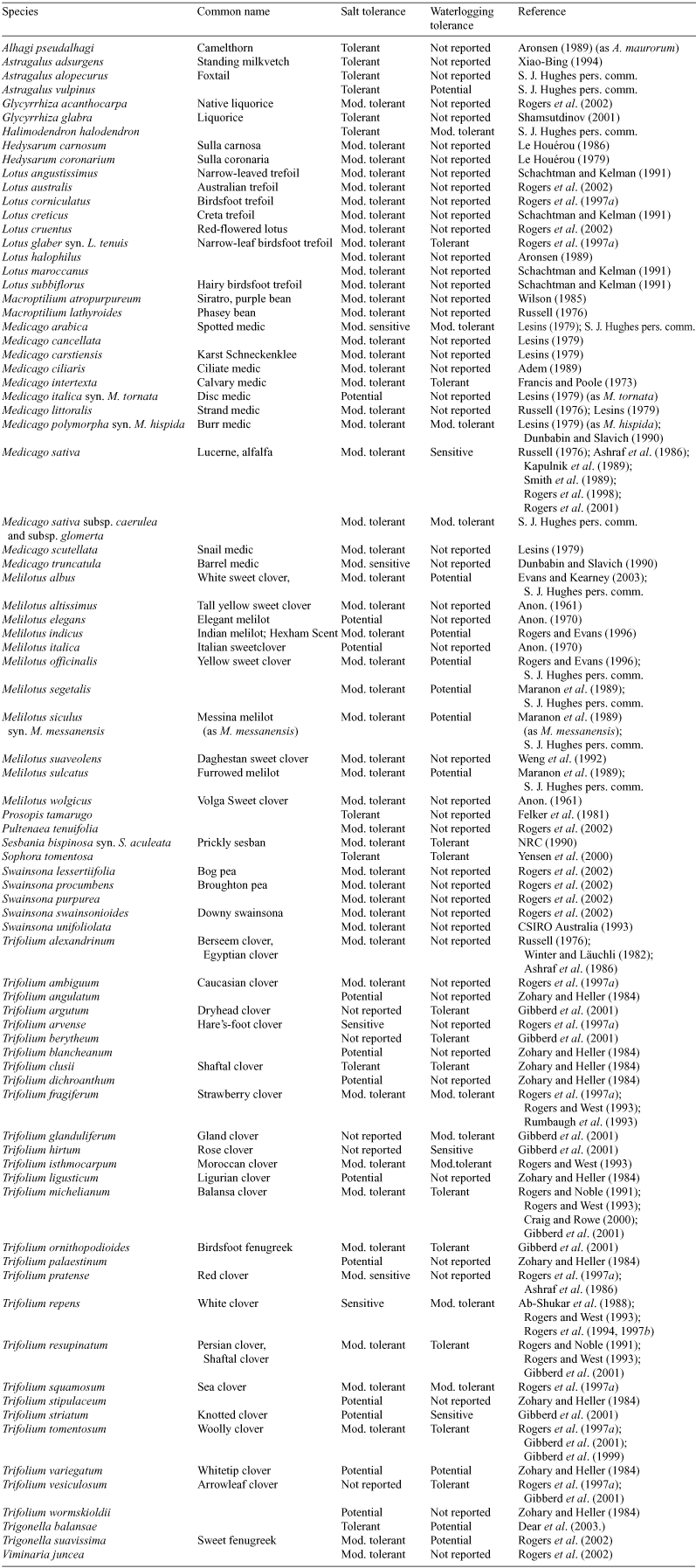
This paper reviews the major issues that impact upon the development of improved fodder species for saline environments across temperate Australia. It describes past and present research that has been, or is being, undertaken towards improvements in salt tolerance in forage species within Australia in relation to the principal regions where salinity occurs. It includes a discussion on the mechanisms of salt tolerance in plants. An extensive list of known or potential salt-tolerant fodder species is provided and the key opportunities for advancement within each of the 4 major forage groups: grasses, legumes, herbs and shrubs are discussed. Constraints to developing new salt and waterlogging tolerant fodder species are identified. A number of recommendations are made for research that should ensure that Australian producers have access to a new array of productive fodder species suited to saline environments.
Acknowledgments
We thank the CRC for Plant-based Management of Dryland Salinity for providing the resources and opportunity to prepare this review and the various State and Federal Agencies for their support. We also appreciate the valuable comments made by Drs A. Ridley, R. Oram and 2 anonymous referees.
Ab-Shukar NA,
Kay QON,
Stevens DP, Skinbinski DOF
(1988) Salt tolerance in natural populations of Trifolium repens L. New Phytologist 109, 483–490.
(verified 26 March 2005).
Kim KS,
Yoo YK, Lee GJ
(1991) Comparitive salt tolerance study in Korean lawngrasses. I. Comparison with western turfgrass via in vitro salt tolerance test. Journal of the Korean Society for Horticultural Science 32, 117–123.
(verified 26 March 2005).
Noble CL,
Halloran GM, West DW
(1984) Identification and selection for salt tolerance in lucerne (Medicago sativa L.). Australian Journal of Agricultural Research 35, 239–252.
| Crossref | GoogleScholarGoogle Scholar |

Oram RN,
Edlington JP, Gardner PA
(2002) Selection for resistance to salinity and waterlogging in Phalaris aquatica L. Australian Journal of Agricultural Research 53, 391–399.
| Crossref | GoogleScholarGoogle Scholar |
Pasternak D,
Nerd A, De Malach Y
(1993) Irrigation with brackish water under desert conditions. IX. The salt tolerance of six forage crops. Agricultural Water Management 24, 321–334.
| Crossref | GoogleScholarGoogle Scholar |
Peng Y-H,
Zhu Y-F,
Mao Y-Q,
Wang S-M,
Su W-A, Tang Z-C
(2004) Alkali grass resists salt stress through high [K+] and endodermis barrier to Na+. Journal of Experimental Botany 55, 939–949.
| Crossref | GoogleScholarGoogle Scholar | PubMed |
Priebe A, Jager HJ
(1978) Influence of NaCl on growth and ion content of plants differing in salt tolerance. Angewandte Botanik 52, 331–341.
Qadir M,
Qureshi RH,
Ahmad N, Ilyas M
(1996) Salt-tolerant forage cultivation on a saline-sodic field for biomass production and soil reclamation. Land Degradation and Development 7, 11–18.
| Crossref | GoogleScholarGoogle Scholar |
Rengasamy P
(2002) Transient salinity and subsoil constraints to dryland farming in Australian sodic soils: an overview. Australian Journal of Experimental Agriculture 42, 351–361.
| Crossref |
Rengasamy P,
Green RSB,
Ford GW, Mehanni AH
(1984) Identification of dispersive behaviour and management of red-brown earths. Australian Journal of Soil Research 22, 413–431.
| Crossref |
Rengasamy P,
Chittleborough D, Helyar K
(2003) Root zone constraints and plant-based solutions for dryland salinity. Plant and Soil 257, 249–260.
| Crossref | GoogleScholarGoogle Scholar |
Richards RA
(1983) Should selection for yield in saline regions be made on saline or non-saline soils? Euphytica 32, 431–438.
| Crossref | GoogleScholarGoogle Scholar |
Richards RA
(1992) Increasing salinity tolerance of grain crops: is it worthwhile? Plant and Soil 146, 89–98.
| Crossref | GoogleScholarGoogle Scholar |
Richards RA,
Dennett CW,
Qualset CO,
Epstein E,
Norlyn JD, Winslow MD
(1987) Variation in yield and grain and biomass in wheat, barley and triticale in a salt-affected field. Field Crops Research 15, 277–287.
| Crossref | GoogleScholarGoogle Scholar |
Rogers AL, Bailey ET
(1963) Salt tolerance trials with forage plants in south-western Australia. Australian Journal of Experimental Agriculture and Animal Husbandry 3, 125–130.
| Crossref |
Rogers ME
(2001) The effect of saline irrigation on lucerne production: shoot and root growth, ion relations and flowering incidence in six cultivars grown in northern Victoria, Australia. Irrigation Science 20, 55–64.
| Crossref | GoogleScholarGoogle Scholar |
Rogers ME,
Grieve CM, Shannon MC
(1998) Variation in the growth of lucerne (Medicago sativa L.) in response to sulphate salinity. Plant and Soil 202, 271–280.
| Crossref | GoogleScholarGoogle Scholar |
Rogers ME, Noble CL
(1991) The effect of NaCl on the establishment and growth of balansa clover (Trifolium michelianum Savi var. balansae Boiss.) Australian Journal of Agricultural Research 42, 847–857.
| Crossref | GoogleScholarGoogle Scholar |
Rogers ME,
Noble CL, Pederick RJ
(1996) Identifying suitable temperate grass species for saline areas. Australian Journal of Experimental Agriculture 36, 197–202.
| Crossref |
Rogers ME,
Noble CL, Pederick RJ
(1997a) Identifying suitable temperate forage legume species for saline areas. Australian Journal of Experimental Agriculture 37, 639–645.
| Crossref | GoogleScholarGoogle Scholar |
Rogers ME,
Noble CL,
Halloran GM, Nicolas ME
(1997b) Selecting for salt tolerance in white clover (Trifolium repens): chloride ion exclusion and its heritability. New Phytologist 135, 645–654.
| Crossref | GoogleScholarGoogle Scholar |
Rogers ME,
Noble CL,
Nicolas ME, Halloran GM
(1994a) Leaf, stolon and root growth of white clover (Trifolium repens L.) in response to irrigation with saline water. Irrigation Science 15, 183–194.
| Crossref |
Rogers ME,
Noble CL,
Halloran GM, Nicolas ME
(1994b) The effect of NaCl on the germination and early seedling growth of white clover (Trifolium repens L.) populations selected for high and low salinity tolerance. Seed Science and Technology 23, 277–287.
Rogers ME, West DW
(1993) The effects of rootzone salinity and hypoxia on shoot and root growth in Trifolium species. Annals of Botany 72, 503–509.
| Crossref | GoogleScholarGoogle Scholar |
Roundy BA
(1993) Response of basin wildrye and tall wheatgrass seedlings to salinisation. Agronomy Journal 75, 65–71.
Rozema J,
Rozema-Dijst E,
Freijsen AHJ, Huber JJL
(1978) Population differentiation within Festuca rubra L. with regard to soil salinity and soil water. Oecologia 34, 329–341.
| Crossref | GoogleScholarGoogle Scholar |
Rumbaugh MD, Pendery BM
(1990) Germination salt resistance of alfalfa (Medicago sativa L.) germplasm in relation to subspecies and centres of diversity. Plant and Soil 124, 47–51.
Rumbaugh MD,
Pendery BM, James DW
(1993) Variation in the salinity tolerance of strawberry clover (Trifolium fragiferum L.) Plant and Soil 153, 265–271.
| Crossref | GoogleScholarGoogle Scholar |
Russell JS
(1976) Comparative salt tolerance of some tropical and temperate legumes and tropical grasses. Australian Journal of Experimental Agriculture and Animal Husbandry 16, 103–109.
| Crossref |
Schachtman DP, Kelman WM
(1991) Potential of Lotus germplasm for the development of salt, aluminium and manganese tolerant pasture plants. Australian Journal of Agricultural Research 42, 139–149.
| Crossref | GoogleScholarGoogle Scholar |
Schwab KB, Gaff DF
(1990) Influence of compatible solutes on soluble enzymes from desiccation-tolerant Sporobolus stapfianus and desiccation-sensitive Sporobolus pyramidaris.
Journal of Plant Physiology 137, 208–215.
Semple WS, Cole IJ
(2002) Native grasses for saline site revegetation. Stipa Newsletter 21, 6–11.
Semple WS,
Cole IA, Koen TB
(2003) Performance of some perennial grasses on severely salinised sites in the inland slopes of New South Wales. Australian Journal of Experimental Agriculture 43, 357–371.
| Crossref | GoogleScholarGoogle Scholar |
Setter TL, Waters I
(2003) Review of prospects for germplasm improvement for waterlogging tolerance in wheat, barley and oats. Plant and Soil 253, 1–34.
| Crossref | GoogleScholarGoogle Scholar |
Short DC, Colmer TD
(1999) Salt tolerance in the halophyte Halosarcia pergranulata subsp. pergranulata.
Annals of Botany 83, 207–213.
| Crossref | GoogleScholarGoogle Scholar |
Slavich PG,
Smith KS,
Tyerman SD, Walker GR
(1999) Water use of grazed salt bush plantations with saline water table. Agricultural Water Management 39, 169–185.
| Crossref | GoogleScholarGoogle Scholar |
Smith SE,
Poteet DC,
Robinson DL, Dobrenz AK
(1989) Stability of salt tolerance at germination in lucerne following seed multiplication at a non-saline site. Seed Science and Technology 17, 555–561.
Staal M,
Maathuis FJM,
Elzenga TM,
Overbeek HM, Prins HBA
(1991) Na+/H+ antiport activity in tonoplast vesicles from roots of the salt-tolerant Plantago maritima and the salt-sensitive Plantago media
Physiologia Plantarum 82, 179–184.
| Crossref | GoogleScholarGoogle Scholar |
Sundararaj DD,
Ramakrishnan V,
Khan AMMA, Vijayan KP
(1975)
Sporobolus orientalis Kunth. and S. tremulus Kunth. — two new lawn grasses for coastal and saline tracts. South Indian Horticulture 23, 73–74.
Teakle LJH, Burvill GH
(1938) The movement of soluble salts in soils under light rainfall conditions. Journal of Agriculture of Western Australia 15, 218–245.
Tursunay Gao HY,
An SZ,
Li W,
Gao HY, An SZ
(1995) Comprehensive evaluation of salt resistance of eight herbage species. Grassland of China 1, 30–32.
Ungar IA
(1978) Halophyte seed germination. Botanical Review 44, 233–264.
Venables AV, Wilkins DA
(1978) Salt tolerance in pasture grasses. New Phytologist 80, 613–622.
Waghorn GC,
Douglas GB,
Niezen JH,
McNabb WC, Foote AG
(1998) Forages with condensed tannins — their management and nutritive value for ruminants. Proceedings of the New Zealand Grassland Association 60, 89–98.
Warwick NWM, Halloran GM
(1991) Variation in salinity tolerance and ion uptake in accessions of brown beetle grass (Diplachne fusca L. Beauv.). New Phytologist 119, 161–168.
Weimberg R, Shannon MC
(1988) Vigor and salt tolerance in three lines of tall wheatgrass. Physiologia Plantarum 73, 232–237.
Weng SH,
Jiang YQ, Wang CB
(1992) A preliminary study of indices and methods for evaluating salt tolerance in forage plants. Grassland of China 1, 30–34.
Wilson JR
(1985) Comparative response to salinity of the growth and nodulation of Macroptilium atropurpureum cv. Siratro and Neonotonia wightii cv. Cooper seedlings. Australian Journal of Agricultural Research 36, 589–599.
| Crossref | GoogleScholarGoogle Scholar |
Winter E, Läuchli A
(1982) Salt tolerance of Trifolium alexandrinum L. I. Comparison of salt response of T. alexandrinum and T. pratense.
Australian Journal of Plant Physiology 9, 221–226.
Xiao-Bing
(1994) A study of the critical and ultimate salt tolerance values of five legumes. Pratacultural Science 11, 70–73.

|
|

|