

Molecular Modelling: All the Way from Atomistic Structure to Function in Complex Systems
Sean C. Smith and Qiao Sun
pp. 343-344
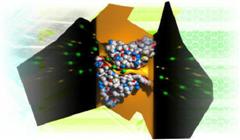
Sean Smith and Qiao Sun provide a thematic overview of the recent Molecular Modelling 2009 (MM2009) conference hosted by the Association of Molecular Modellers of Australasia (www.mgms.org.au). The MM2009 meeting was held at the Gold Coast in Queensland, 26–29 July, 2009. It was attended by a substantive grouping of Australian as well as international participants, drawn from a wide range of disciplines for which molecular modelling represents a convergent interest. (Picture: signature graphic from AMMA website. Concept by Sean Smith with original ion-channel graphic from Ben Corrie and Shin-Ho Chung).
Modelling Copper Binding to the Amyloid-β Peptide in Alzheimer
V. Chandana Epa, Victor A. Streltsov and Joseph N. Varghese
pp. 345-349
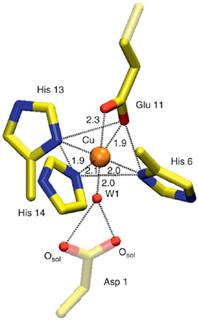
Oxidative modification due to reactive oxygen species (ROS) generated by Cu2+ bound to the amyloid--β peptide may be one of the sources of neurodegeneration observed in Alzheimer’s disease. We highlight some of the significant recent developments in modelling studies of the structure of the binding site and reaction mechanisms of ROS generation.
Interactions of Visinin-like Proteins with Phospho-inositides
Karl-Heinz Braunewell, Blessy Paul, Wassim Altarche-Xifro, Cornelia Noack, Kristian Lange and Andreas Hofmann
pp. 350-356
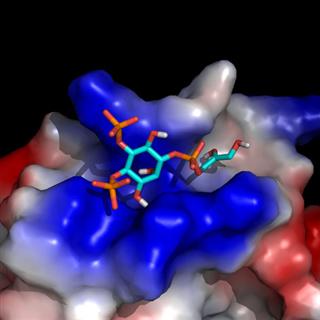
Molecular modelling results support a binding site for phospho-inositides in the N-terminal area of the neuronal calcium sensor protein Visinin-like Protein 1 (VILIP-1), and the involvement of conserved N-terminal lysine residues. Experimentally, the modelling results are corroborated by monolayer adsorption measurements, phosphatidylinositol phosphate strip assay, and immunofluorescence.
Applying Bi-directional Jarzynski Methods to Quasi-equilibrium States
James C. Reid, Stephen R. Williams and Debra J. Searles
pp. 357-362

Many systems exit in a persistent form that is not the lowest free energy state available. Previous work has shown that the free energy of some of these systems can be measured using a non-equilibrium method, the Jarzynski equality. We show an improved sampling method, the Maximum Likelihood Estimator, can be applied to these systems.
Structural and Relaxation Effects in Proton Wire Energetics: Model Studies of the Green Fluorescent Protein Photocycle
Qiao Sun, Sufan Wang, Hong Zhang, Zhen Li, Christoph Pifisterer, Stefan Fischer, Shinko Nanbu and Sean C. Smith
pp. 363-370
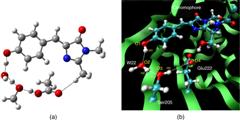
In the present work we have explored the possible impact of structural and dynamical constraints on the effective barrier to proton chain transfer within the context of a cluster model as well as a solvated protein model for the ground electronic state proton transfer in the green fluorescent protein.
First-Principle Study of Atomic Hydrogen Interaction with a Fluorinated Corannulene Radical
Hong Zhang, Sean C. Smith, Shinkoh Nanbu and Hiroki Nakamura
pp. 371-378
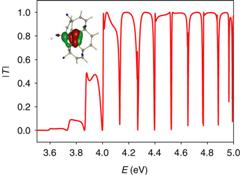
Hydrogen transmission through a fluorinated model ring system (C15H10F5) can form endohedral H@C15H10F5 resonance complexes between H and the ring system. Complete reflection from or transmission through the ring system for specific energies is another interesting phenomenon that might find applications in molecular switching.
Estimating Relative Disulfide Energies: An Accurate Ab Initio Potential Energy Surface
Naomi L. Haworth, Jason Y. Liu, Samuel W. Fan, Jill E. Gready and Merridee A. Wouters
pp. 379-387
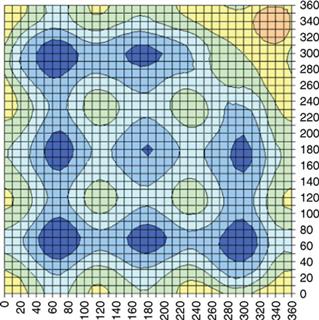
A M05-2X/6-31G(d) quantum chemical potential energy surface has been generated for the torsion of diethyl disulfide. This has been used as the basis of a web application for the prediction of the relative torsional energy of protein disulfide bonds and thus their likelihood of being involved in redox-activity.
Molecular Modelling of Ground- and Excited-States Vibrations in Organic Conducting Devices: Hexakis(n-hexyloxy)triphenylene (HAT6) as Case Study
M. Zbiri, M. R. Johnson, L. Haverkate, F. M. Mulder and G. J. Kearley
pp. 388-395
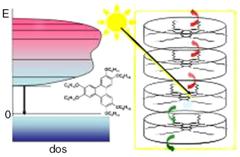
Relaxation processes between electronically excited states and into the ground state cause high losses in organic photovoltaic materials. DFT calculations of the HAT6 discotic molecule show considerable differences between the molecular vibrations of the ground and electronically excited states, with the aliphatic tails playing a surprisingly important role.
Binding Mode Prediction of PDE4 Inhibitors: A Comparison of Modelling Methods
Diana S. Neale, Philip E. Thompson, Paul J. White, David K. Chalmers, Elizabeth Yuriev and David T. Manallack
pp. 396-404
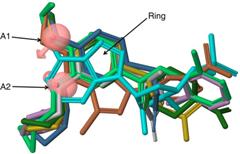
In this study, three methods – molecular docking (Glide), shape similarity (ROCS), and pharmacophore modelling (Phase) – were evaluated for their ability to reproduce the experimentally determined binding mode of 25 PDE4 inhibitors. Molecular docking performed well providing a good approximation (RMSD less than 2 Å) in 59% of cases.
Allosteric Conformational Transition in Adenylate Kinase: Dynamic Correlations and Implication for Allostery
Ming S. Liu, Billy D. Todd and Richard J. Sadus
pp. 405-412
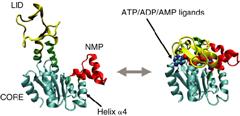
Protein mechanisms of how dynamics regulate functions are largely unknown at the molecular level. We applied a coarse-grained dynamics simulation of adenylate kinase (AdK), a biologically important system, and compared with experiments and all-atom molecular simulations. In AdK, we identified pivotal dynamics responsible for the competitive order of ligand binding, and found long-range correlated motion lead to allosteric transition and cooperativity. A dynamic criterion to elucidate allostery in structural transitions is also proposed.
Computational Photobiology and Beyond
Igor Schapiro, Mikhail N. Ryazantsev, Wan Jian Ding, Mark M. Huntress, Federico Melaccio, Tadeusz Andruniow and Massimo Olivucci
pp. 413-429
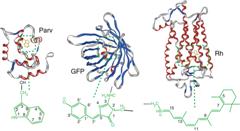
Computational studies of the spectroscopy and photochemistry of selected light-responsive proteins are reviewed. The paper focuses on the use of quantum mechanics/molecular mechanics protocols based on a multiconfigurational quantum chemical treatment. Finally, it is reported how the light-driven artificial molecular devices can be designed based on the visual photoreceptor rhodopsin.
Adsorption and Dipole Surface Orientational Order at Liquid Surfaces
Bruce M. Law, Jae-Hie Cho, John Carpenter and Dan Smith
pp. 430-433
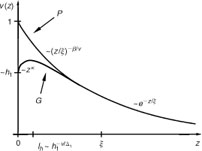
We quantify adsorption at the liquid/vapour surface of a critical binary liquid mixture. Depending upon the relative surface tensions of the two liquid components and upon their dipole moments, one can find strong adsorption (P), weak adsorption (G), or dipole surface orientational order at this interface.
Concentration Depth Profiles of Inorganic Ions at Liquid Surfaces
Gunther Andersson
pp. 434-437
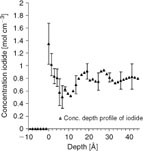
Neutral Impact Collision Ion Scattering Spectroscopy is one of the few experimental methods to directly determine concentration depth profiles of inorganic ions at liquid surfaces. The large and polarizable iodide ion shows preferential adsorption at the surface of solutions with the polar solvent formamide whereas the smaller and less polarizable chloride ion does not.
Synthesis of the Leu–Trp Component of the Celogentin Family of Cyclic Peptides Through a C–H Activation–Cross-Coupling Strategy
Barbara T. Y. Li, Jonathan M. White and Craig A. Hutton
pp. 438-444
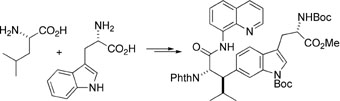
A bioinspired oxidative coupling approach to the central leucine(C3)–tryptophan(C6) cross-linked moiety present in the celogentin family of cyclic peptide natural products was achieved. The key transformation was achieved through a palladium catalysed C–H activation–cross-coupling of leucine quinoline amide and 6-iodotryptophan derivatives. The method enables the preparation of the Leu–Trp adduct as a single stereoisomer from L-leucine and L-tryptophan.
Spiroheterocycles via Regioselective Cycloaddition Reactions of Nitrile Oxides with 5-Methylene-1H-pyrrol-2(5H)-ones
Nicola J. Beattie, Craig L. Francis, Andris J. Liepa and G. Paul Savage
pp. 445-451
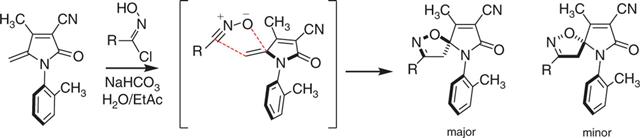
Nitrile oxide cycloadditions with substituted methylene lactams give spiro heterocycles, regioselectively. A novel biphasic system for the base-induced dehydrohalogenation of hydroximoyl chlorides to nitrile oxides was critical in this reaction as the methylene lactam precursors are base-sensitive. Atropisomerism in the dipolarophile led to a 4:1 facial selectivity during cycloaddition.
Structure and Characterization of a Novel 3D Lead Phosphonate Metal–Organic Framework with Cationic Layer Based on Weak Pb–O(N) Contact
Kui-Rong Ma, Dao-Jun Zhang and Yu-Lan Zhu
pp. 452-457
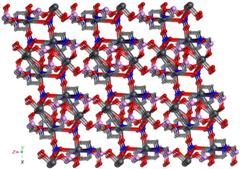
A novel lead-phosphonate, [Pb2(HL)]·(NO3)·2(H2O) 1 (HL = O3PCH2NH(C4H8)NCH2PO3), has been hydrothermally synthesized. Compound 1 possesses a 2D cationic layer structure built from inorganic chains with three types of eight-membered rings arranged in an ABAC manner. When the bond length of Pb–O(N) extended to 3.10 Å, a 3D metal-organic framework was constructed via long Pb–O(N) contacts.
On the Solid-State Isomerization of Terpinolene Tetrabromide
Paul V. Bernhardt, Raymond M. Carman and Tri T. Le
pp. 458-462
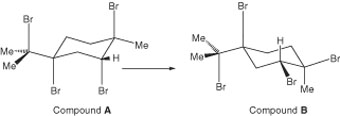
Isomerization of terpinolene tetrabromide from its unstable cis-2,4- (diaxial) dibromo isomer (compound A) to the more stable trans-2,4-equatorial–axial compound B has been followed in the solid state by powder XRD and proceeds via a previously unknown and metastable triclinic polymorph of compound A (characterized crystallographically) to give compound B as a stable product.
Coordination Polymers with a Bulky Perylene-Based Tetracarboxylate Ligand: Syntheses, Crystal Structures, and Luminescent Properties
Chun-Sen Liu, Min Hu, Song-Tao Ma, Qiang Zhang, Li-Ming Zhou, Li-Jun Gao and Shao-Ming Fang
pp. 463-473
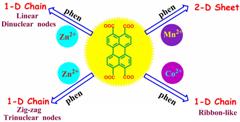
The construction of four new ZnII, MnII, and CoII coordination polymers composed of 2D sheet and 1D chain structures has been successfully achieved by using the bulky perylene-3,4,9,10-tetracarboxylate (ptc) ligand together with the 1,10-phenanthroline (phen) chelating ligand. The present findings may offer the means to construct coordination architectures with novel structures just by consideration of the steric bulk of the aromatic skeleton. Further, the luminescent properties of the complexes have been investigated.
Theoretical Investigation on Structures and Stabilities of CuXenZ (n = 1–3, Z = –1, 0, +1) Clusters
Li Xinying, Wu Senfeng, Zhou Chengfang and Zhao Yongfang
pp. 474-478
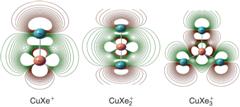
The structures and stabilities of CuXenZ cluster series (where n = 1–3; and Z = –1, 0, +1) have been investigated at a CCSD(T) theoretical level. The natural bond orbital analysis, electron population, orbitals, and laplacian of electron density analysis are investigated to explore the mechanism of the interaction..
Structural Variation and Magneto-Structural Correlation in Two New Dinuclear Bis(µ2-Phenoxo)-Bridged CuII Schiff-Base Complexes: Catalytic Potential for the Peroxidative Oxidation of Cycloalkanes
Subhra Basak, Soma Sen, Partha Roy, Carlos J. Gómez-García, David L. Hughes, Ray J. Butcher, Eugenio Garribba and Samiran Mitra
pp. 479-489
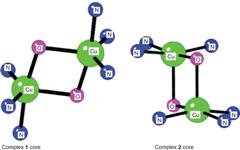
Two new dinuclear bis(µ2-phenoxo)-bridged CuII complexes [Cu(NCS)L1]2 (1) and [Cu(NCS)L2]2 (2) have been synthesized using two tridentate NNO-donor Schiff-base ligands. The five-coordinate CuII ions have distorted trigonal-bipyramidal (TBP) and quasi-regular square-pyramidal (SP) geometry in 1 and 2, respectively and are promising catalysts or catalyst precursors for the efficient peroxidative oxidation of cycloalkanes.
An Alternative Platform for the Assessment of Hückel and Möbius Transition States in Concerted Reactions
Kurt H. R. Hennigar and Richard F. Langler
pp. 490-501
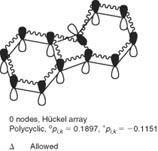
A novel basis for decisions about the allowed/forbidden character of transition states is outlined. Simple generalizations are tabulated for concerted reactions with transition states that feature monocyclic p-orbital arrays. Polycyclic p-orbital arrays can be evaluated computationally (Hückel level).
1,4,7-Tricarboxymethyl-1,4,7-triazacyclononane Copper Catalyzed Oxidative Polymerization to Form Poly(2,6-dimethyl-1,4-phenylene oxide) in Water
Sweta Pant, Milton T. W. Hearn and Kei Saito
pp. 502-506
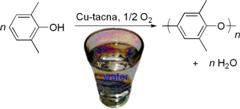
The copper (II) complex of the water soluble ligand 1,4,7-tricarboxymethyl-1,4,7-triazacyclononane has been employed as a catalyst for the oxidative polymerization of 2,6-dimethylphenol to from poly(2,6-dimethyl-1,4-phenylene oxide) using water as the solvent.
A Simple One-Pot, Three Component Synthesis of 3-Arylpyrimido[4,5-c]pyridazine-5,7(6H,8H)-diones and their Sulfur Analogues as Potential Monoamine Oxidase Inhibitors
Mehdi Rimaz, Jabbar Khalafy, Nader Noroozi Pesyan and Rolf H. Prager
pp. 507-510
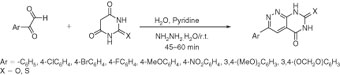
A number of new 3-arylpyrimido[4,5-c]pyridazine-5,7(6H,8H)-diones and 3-aryl-5-oxo-7-thioxo-7,8-dihydropyrimido[4,5-c]pyridazin-5(6H)-ones have been synthesized by a three- component reaction of barbituric acid or thiobarbituric acid with arylglyoxals in the presence of a catalytic amount of pyridine and hydrazine hydrate at room temperature in water..
Phosphonium and Ammonium Ionic Liquids with Aromatic Anions: Synthesis, Properties, and Platinum Extraction
Anja Stojanovic, Daniel Kogelnig, Lisa Fischer, Stephan Hann, Markus Galanski, Michael Groessl, Regina Krachler and Bernhard K. Keppler
pp. 511-524
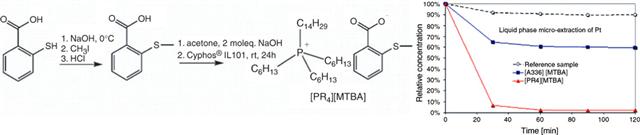
Ionic liquids (ILs) with functionalized aromatic anions were prepared using tricaprylmethylammonium chloride (Aliquat 336) and trihexyl(tetradecyl)phosphonium chloride (Cyphos IL101) as precursors. Thiol and thioether ILs were applied for the extraction of platinum from an aqueous phase. Time dependent studies showed a rapid elimination of up to 95% platinum after 30 min.
On the Superhydrophobic Properties of Crystallized Stearic Acid
Kyle R. Joseph and Chiara Neto
pp. 525-528
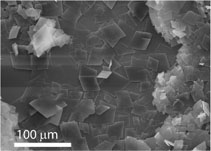
The scanning electron micrograph of a deposit of stearic acid on a silicon wafer shows hydrophobic rhomboid crystals. The crystallization of stearic acid on a substrate in repeated dip-and-dry cycles produces a coating that has superhydrophobic properties. The procedure could easily be applied to large areas and objects of any shape, allowing the use of self-cleaning or anti-fouling coatings in real-life applications.
Asymmetric Synthesis of a Hydroxylated Nine-membered Lactone from Tartaric Acid using the Claisen Rearrangement
Leon S.-M. Wong, Kathleen A. Turner, Jonathan M. White, Andrew B. Holmes and John H. Ryan
pp. 529-532
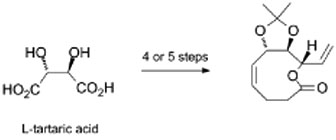
The synthesis of a hydroxylated vinyl-appended lactone, in five synthetic steps from tartaric acid, is reported. The key step is the Claisen rearrangement of a ketene acetal into a nine-membered lactone. Lactones of this type are potentially advanced precursors to simplified eleutherobin analogues or other medium-ring lactone natural products.
RAFT - Latest Innovations seminar, October 28, 2010, Melbourne. Hosted by CSIRO, sponsored by Sigma Aldrich. Hear about new product applications. RSVP to Kate Dawson.
Managing Arsenic in the Environment
An authorative overview of arsenic contamination, its impacts and the latest risk management and remediation strategies. More